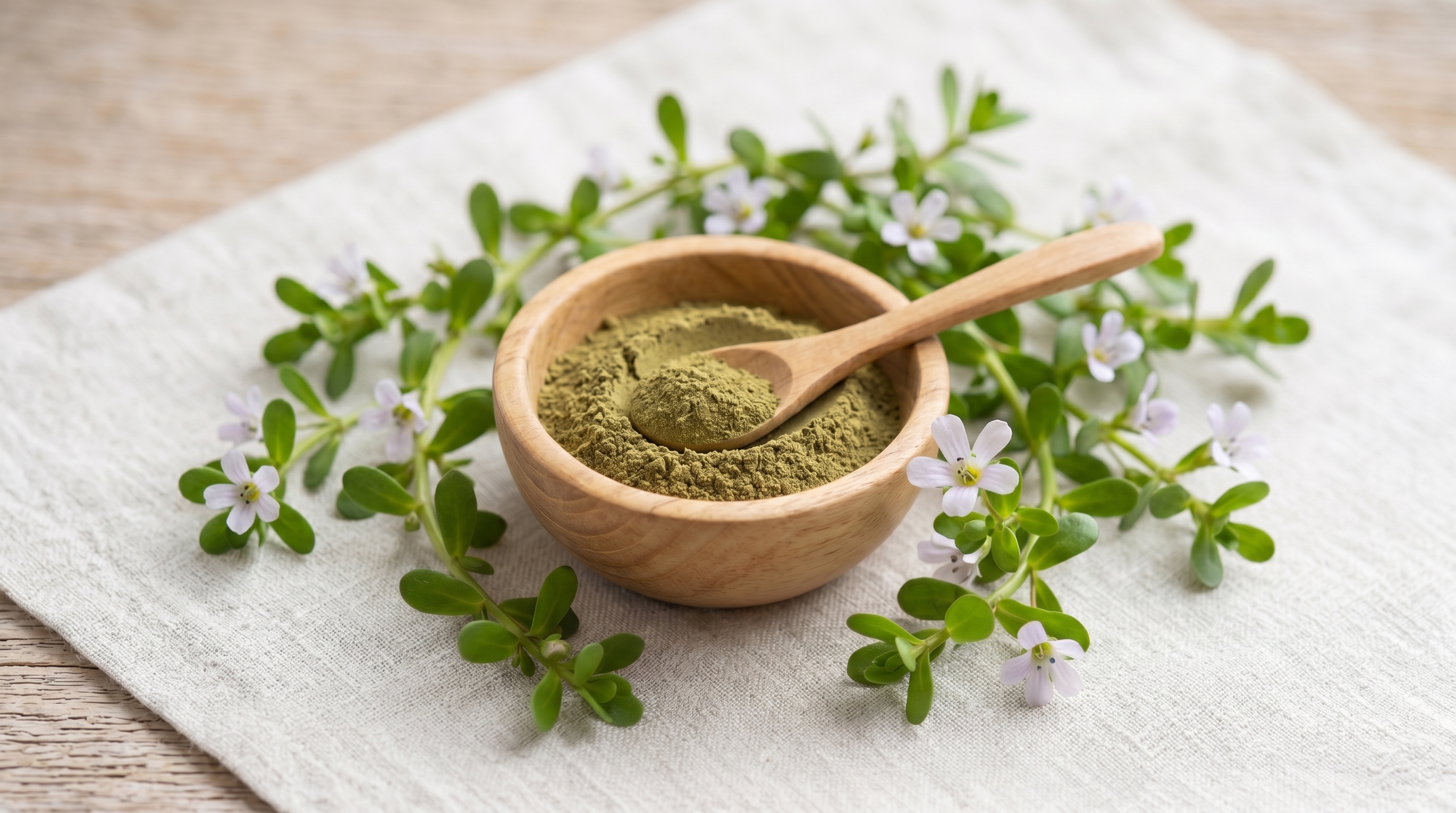
In the Ayurvedic tradition there is a separate category of plants - "medhya rasayana", which literally translates as "that which nourishes the mind". Only a few plants belong to it, and bacopa monnieri (Bacopa monnieri) is the first among them. Its Vedic names are "Brahmi", after Brahma, the god of creation and knowledge, and "saraswati", after the goddess of wisdom. For over two thousand years it was used in the schools of Vedanta to help students memorise long Sanskrit texts by ear. In the 20th century the Indian Central Drug Research Institute isolated the active fraction from the extract of this plant - bacosides A and B. Since then bacopa has become one of the most studied medicinal plants in the world, and it turned out that its action is much broader than the traditional role of a memory herb. Today bacopa is gradually entering the format of a regular drink - similar to matcha and coffee alternatives.
What bacopa monnieri is and where it came from
Bacopa monnieri is a creeping perennial plant of the plantain family (Plantaginaceae). It grows on moist soils and in wetlands of India, Sri Lanka, Southeast Asia, southern China and northern Australia. It has small white or pale blue flowers and rounded fleshy leaves - because of the leaf shape, in English-language literature the plant is sometimes called "moneywort". In a warm climate it blooms almost year-round and is often found in rice fields.
Bacopa's place in the Ayurvedic tradition
In Ayurveda bacopa has not just the role of a medicinal herb but a place in a separate functional category - medhya rasayana, plants for the mind and nervous system. Classical texts describe its action through the concept of "sattva" - clarity of consciousness and the capacity for perception. The Ayurvedic formula Saraswatarishta, still produced on an industrial scale in India, is built on bacopa and is used to support attention and memory in school-age children. The name "saraswati", by which bacopa is called in some regions, comes from the name of the goddess of wisdom - in the Hindu tradition she holds a book and prayer beads, symbols of knowledge and concentration. This name stuck to the plant through its association with absorbing and retaining information.
Standardisation and what the research actually shows
Most of the strong randomised controlled trials of bacopa were conducted on extracts standardised by bacoside content. The one most often mentioned is CDRI 08 - a standard developed at the Central Drug Research Institute in Lucknow (India), with a defined ratio between bacosides A and B and a minimum percentage of total bacosides. The studies of Calabrese, Stough, Benson and Kean - most of the key clinical works of the last twenty years - were built on such raw material.
A useful context about doses. The standard dose of these studies, 300 mg of extract per day, corresponds to an extract from roughly 2 grams of dried plant. The reference point matters: a clinically meaningful amount of active compounds is reachable not only in a capsule but also through a properly prepared infusion or functional drink from a comparable amount of raw material. What is fundamental here is not the packaging or brand, but two other things - the quality of the raw material, that is the concentration of bacosides in the source material, and the regularity of intake, since bacopa's effect forms over weeks. A capsule standardised extract gives the most predictable dosing, powder and drink depend on plant quality. But the clinically studied dose is a reference point achievable in different formats, not the exclusive property of one manufacturer.
What is inside bacopa: the profile of active compounds and how they work
Modern phytochemistry describes bacopa not as one plant with one active substance, but as a matrix of several classes of compounds acting in parallel. The most studied group is bacosides A and B, triterpene saponins that gave the name to the whole chemical class and serve as a marker for standardising extracts. Alongside them, bacopa documents betulinic acid (the same compound known for its presence in chaga), quercetin, apigenin, loliolide, luteolin and aspartic acid derivatives. Each of these compounds has its own documented mechanism of action.
Four mechanisms working in parallel
A systematic review by Valotto Neto and co-authors (2024, Antioxidants) summarised data from 22 clinical and several dozen preclinical works. The authors described four key mechanisms of bacopa's effect on the nervous system.
The first is antioxidant protection of neurons. Quercetin, apigenin and betulinic acid neutralise free radicals in nervous tissue and reduce the oxidative load on neuronal mitochondria. Without healthy mitochondria a neuron cannot effectively generate and transmit signals, so this is a fundamental level.
The second is modulation of inflammation. Bacosides and quercetin reduce the activity of the nuclear factor NF-κB, a key regulator of inflammation in the nervous system. In clinical studies, taking bacopa was accompanied by a reduction in markers of neuroinflammation.
The third is restoration of synaptic function. Bacosides stimulate the synthesis of proteins from which synapses, the contact points between neurons, are built. This is about improving communication between already existing neurons, not about forming new ones.
The fourth is anti-apoptotic action. Under stress or toxic load, bacopa reduces programmed neuron death. In preclinical studies this showed as protection against neurotoxins.
The four mechanisms act simultaneously and are not interchangeable. The broad spectrum of bacopa's clinical effects, from cognitive function to lowering cortisol, is made up of their combined action on the state of nervous tissue, not from the work of a single molecule.
How bacopa differs from ashwagandha and rhodiola
Among adaptogens with a clinical base, bacopa has a distinct primary mechanism.
Ashwagandha (Withania somnifera) acts mainly at the systemic level - through the hypothalamic-pituitary-adrenal axis, cortisol regulation and modulation of the whole body's stress response. Its effects on the nervous system arise as a consequence of this systemic regulation.
Rhodiola rosea (Rhodiola rosea) works through the monoaminergic system, affecting serotonin, dopamine and noradrenaline, plus it compensates fatigue through support of energy metabolism.
Bacopa's vector is different: the primary point of action is the neuron itself, through synaptic function, antioxidant protection and modulation of neuroinflammation. The effect on cortisol and stress appears as a consequence of this primary effect.
The three plants work at different levels of the stress response - systemic, neurotransmitter and cellular - and conceptually complement each other in complex formulas. There are no direct head-to-head studies between them in the literature, so the comparison here relies on the described mechanisms and clinical areas of application, not on a direct contest of efficacy.
How bacopa differs from lion's mane
Bacopa and lion's mane (Hericium erinaceus) are often mentioned side by side because both are positioned as support for the brain. But the mechanisms describe two different logics.
Lion's mane works at the infrastructure level. Hericenones, erinacines and polysaccharide fractions stimulate the synthesis of NGF (nerve growth factor) and BDNF (brain-derived neurotrophic factor) - molecules that regulate the growth, survival and recovery of neurons and their processes.
Bacopa works at the function level. Bacosides and the antioxidant complex support the work of already existing synaptic connections and protect neurons from oxidative and inflammatory load.
To draw an analogy with a building - lion's mane supports the structure itself, bacopa improves how it works. The mechanisms do not overlap, so in complex formulas for cognitive support they are often combined.
Cognitive function in adults: what the studies showed
The most cited study of bacopa's cognitive effects in adults was conducted by the Calabrese group at the Helfgott Research Institute (Portland, USA) and published in 2008 (Journal of Alternative and Complementary Medicine). It was a randomised double-blind placebo-controlled study involving 54 healthy people aged 65 and over with no signs of dementia. Participants took 300 mg of standardised extract per day for 12 weeks. In the bacopa group, a significant improvement was recorded in delayed word recall on the Rey test (AVLT) - the ability to recall a learned list after a delay - and in Stroop test results, which assess the ability to ignore irrelevant information. Additionally, in this group anxiety scores and heart rate decreased, while in the placebo group they rose.
Why the effect appears over weeks
A key detail of the Calabrese study is duration. The memory improvement was recorded not immediately, but after twelve weeks of regular intake. This is consistent with the mechanism: restoration of synaptic function and antioxidant protection unfold gradually and require a regular supply of active compounds. Bacopa does not give an instant lift in alertness like caffeine. Its logic is support of the state of nervous tissue with regular use.
Separately about the scale of subsequent work. The Australian ARCLI project (Stough and co-authors) is one of the largest clinical studies of bacopa: 465 participants, observation over 12 months, with assessment of cognitive, cardiovascular and biochemical indicators. The scale and duration themselves show how seriously bacopa is being studied in modern science.
Where the evidence base ends: the line between normal ageing and neurodegeneration
Here a distinction is needed that is often blurred in popular materials. The data on cognitive support concern people with normal age-related decline of cognitive functions, not patients with an established neurodegenerative disease.
A systematic review by Basheer and co-authors (2022, Interactive Journal of Medical Research) analysed five randomised studies of bacopa use in dementia due to Alzheimer's disease. The conclusion is restrained: the quality of evidence was rated as very low, and no difference was found between bacopa and placebo or between bacopa and donepezil (the standard drug for Alzheimer's). The phase 2b study by Prabhakar and co-authors (2020), comparing bacopa with donepezil, had to be stopped early due to slow recruitment and a high dropout rate.
This is not a contradiction in the data but a difference of contexts. Normal age-related decline of memory and concentration is a functional state that bacopa may, according to the available data, influence. Alzheimer's disease is a neurodegenerative process with neuron death, where support of synaptic function no longer compensates for structural losses. Bacopa is not a remedy for treating dementia. Any use in the context of a serious neurological disease is possible only after consultation with a doctor and as an addition to the main treatment.
Acute stress and cortisol: a fast effect that does not fit the usual logic
Most data on bacopa describe a cumulative effect - weeks of regular intake. But there is a study that shows the other side. The Benson group from Swinburne University (Australia) in 2014 (Phytotherapy Research) conducted a randomised crossover study: the same participants on different days received placebo, 320 mg and 640 mg of bacopa. One to two hours after intake they took a multitasking stress test - a computer task that loads attention with several parallel tasks and induces measurable stress.
The result was unexpected. Bacopa improved cognitive performance already within an hour or two, in particular in search tasks and the Stroop test. In parallel, the level of cortisol in saliva decreased during the stress test. A single intake gave both a cognitive and a physiological stress effect within hours, not weeks.
Two modes of action of one plant
The picture turns out to be interesting. On one side are Calabrese's data on cumulative memory improvement over twelve weeks. On the other are Benson's data on an acute effect on stress and concentration within one or two hours. The most likely explanation: bacopa has two parallel modes of action. The fast one is situational modulation of the stress response and concentration, noticeable on the day of intake. The slow one is cumulative support of synaptic function, forming over weeks. The first fits the format of a regular drink for periods of load, the second fits systemic long-term use.
Caution is needed here. The Benson study was small, only 17 participants, and its results require confirmation on a larger sample. This is a signal of a promising direction, not a definitively proven effect.
The context of combined formulas
A similar logic is supported by the work of Tartar and co-authors (2021, Cureus). In a 21-day study a phytoblend with bacosides and other plant components improved attention and alertness relative to placebo and caffeine. A separate detail: after physical load, the blend group did not show the expected rise in stress catecholamines, which the authors interpret as a reduction in stress reactivity with regular intake.
Calibration matters here - this was a combined product, not isolated bacopa, so the effect cannot be fully attributed to it alone. But the direction coincides with Benson's data: bacopa affects stress reactivity, and the effect appears faster than the classic picture of twelve weeks to a result.
Children and executive function: an unexpected direction of research
Most bacopa studies concern adults and older people. But one of the most interesting RCTs of recent years studied children. The Kean team from Swinburne University (Australia) in 2022 (Phytotherapy Research) published the results of a 14-week randomised double-blind placebo-controlled study involving 112 boys aged 6-14 with signs of inattention (reduced attentiveness) and hyperactivity. The final analysis included data from 93 participants.
What the study showed and did not show
The result was ambiguous, and that is exactly what makes it valuable. Behavioural indicators of hyperactivity on the standard Conners scale did not significantly improve - bacopa did not reduce hyperactive behaviour itself.
Instead, improvement was recorded in other domains. In the bacopa group the number of errors in cognitive tasks decreased, and cognitive flexibility (the ability to switch between tasks) and executive functions (planning, impulse control, keeping attention on a goal) improved. Separately, better sleep and a reduction in interpersonal problems were noted. The effect appeared not at the level of behaviour but at the level of the cognitive processes that underlie it.
Why this direction is interesting
A contrast emerges here. The classic theme of bacopa is memory support in older people. And this study shows action at the opposite end of the age spectrum, in children, and through a different aspect of cognition - executive function instead of memory. The same standardised extract works in both contexts but addresses different cognitive systems. This explains well why bacopa is hard to reduce to a single function.
Calibration is needed here too. This is one study, conducted exclusively on boys, with no data on girls. The results require confirmation on a broader and mixed-sex sample. And a fundamental point: bacopa is not a replacement for the psychiatric or paediatric approach to attention-deficit hyperactivity disorder. Regular use of bacopa by a child is possible only after consultation with a paediatrician who takes into account the individual condition and the full picture.
Can bacopa be combined with other adaptogens
This is one of the most frequent questions about bacopa. The answer follows from a simple principle: it makes sense to combine components with different mechanisms that complement each other, rather than duplicate. Two plants working through one pathway, when combined, give only a higher dose. Two plants with different mechanisms cover a broader spectrum of processes. Bacopa, with its primary action on the neuron, combines well with components that work at other levels of the nervous system.
Pairings with clear logic
Bacopa and gotu kola are the most traditional pair. Both plants belong to the Ayurvedic category medhya rasayana and have been used together for centuries. Gotu kola (Centella asiatica) acts mainly through microcirculation, vascular support and modulation of GABA, the inhibitory neurotransmitter associated with calm. Bacopa works through synaptic plasticity and antioxidant protection. Two different entries into the nervous system, which tradition combined long before the biochemical description of the mechanisms.
Bacopa and ashwagandha are two levels of the stress response. Ashwagandha regulates stress systemically, through the hypothalamic-pituitary-adrenal axis and cortisol. Bacopa acts at the level of the neuron itself. In complex formulas for stress and cognitive support they approach the problem from different sides, systemic and cellular.
Bacopa and lion's mane are conceptually one of the strongest pairs for cognitive support. Lion's mane, through NGF and BDNF, supports the neurotrophic link, the growth and recovery of neurons. Bacopa improves the work of already existing synaptic connections. Infrastructure and function complement each other. There are no direct clinical studies of this exact combination - it is a pairing at the level of mechanism logic, not a synergy proven in RCTs.
Pairings with nuances
Bacopa and ginkgo have complementary mechanisms: ginkgo improves cerebral blood flow through vasodilation, bacopa works at the synaptic level. But there is a safety point here. Ginkgo has an antiplatelet profile, that is, it reduces the ability of platelets to stick together. With the simultaneous intake of anticoagulants or antiplatelet agents (warfarin, aspirin, clopidogrel), the combination with ginkgo requires consultation with a doctor. Bacopa itself does not have this profile - ginkgo adds it.
Bacopa and reishi are not a direct synergy but a broader spectrum of support. Reishi (Ganoderma lucidum) acts mainly through immune modulation and parasympathetic activation, with which its reputation for sleep and calm is associated. Bacopa works through neuroplasticity. The mechanisms do not conflict, but they do not complement each other as directly as in the previous pairs. This is a combination for those who are building broader support of the nervous system and sleep, rather than a targeted cognitive formula.
A general limitation that is important to understand
Everything described above is the logic of combinations at the level of the mechanisms of individual components. Randomised controlled trials of the combinations themselves are almost non-existent, and those that exist are mostly multi-component: they contain three or more plants, which does not allow the contribution of a specific pair to be isolated. The mechanism of each individual component has its own evidence base, but the synergy of specific combinations is, for the most part, a reasonable theoretical expectation and the experience of traditional use, not a clinically proven fact. The honest boundary: combinations expand the spectrum of action by logic but do not guarantee a multiplied effect.
Powder, extract, capsules: which form for which goal
Bacopa is available in several forms, and the choice between them is a question of goal and context of use, not quality. Each form has its own logic.
Powder from the ground dried plant retains the full matrix profile - bacosides, betulinic acid, quercetin, apigenin and other components in their natural ratio, together with plant fibre. The bacoside content in powder is lower than in a concentrated extract, so a larger volume of raw material is needed for a comparable dose of active compounds. Powder does not dissolve fully - it is brewed in hot water or added to drinks and dishes. The taste is characteristic, slightly bitter, which is worth taking into account when choosing the format. The logic of use is daily enrichment of the diet with the full spectrum of the plant's components, including as a base for a functional drink.
Extract, water or water-alcohol based, contains a standardised concentration of bacosides, usually from 20% and above. In the extraction process, the active fractions are released from the plant matrix and become water-soluble and bioavailable regardless of digestion features. Part of the matrix components, plant fibre and some insoluble fractions, is reduced or absent in the extract. The advantage of an extract is predictable dosing, and it is precisely standardised extracts that were used in most clinical studies. The logic of use is when a precise concentration of active compounds and regular intake for a cumulative effect are needed.
Capsules contain the same standardised extract in a fixed dose. The practical advantage is precise dosing without brewing or measuring, no contact with a bitter taste, convenience in a tight daily rhythm. The dose reference is about 300 mg of extract per day, which corresponds to an extract from roughly 2 grams of dried plant, that is the amount on which most clinical studies in adults were built. The logic of use is regular intake with precise dose control and without a culinary context.
The choice between forms is not a question of quality but of goal and lifestyle. Powder gives the full plant profile and flexibility in the way of use. Extract and capsules give a predictable concentration and the convenience of regular intake.
Bacopa as a daily ritual: the functional drink format
The functional drink format is noticeably gaining momentum. Matcha, chicory, mushroom coffee, adaptogenic teas are gradually becoming part of daily rituals instead of a simple source of caffeine. Bacopa fits this logic well, and the reason is not marketing but mechanistic.
Why the drink format suits bacopa in particular
Bacopa's main effect is cumulative. Calabrese's data showed an improvement in cognitive indicators after twelve weeks of regular intake. Synaptic support and antioxidant protection unfold gradually and require a regular supply of active compounds. A drink is one of the most natural formats for daily use. It fits into an existing habit: the morning cup, the daytime pause, the evening ritual. In this sense the drink format works together with bacopa's pharmacokinetics, not against it - the regularity that the cumulative effect requires is easier to maintain through a ritual than through a course of intake.
How it differs from coffee and matcha
It is important not to oppose but to distinguish the tools. Coffee and matcha work through caffeine - a fast, noticeable rise in alertness for a few hours that ends in a decline. Matcha adds L-theanine, which smooths the caffeine peak. Bacopa acts through support of the state of nervous tissue, synaptic function and antioxidant protection, which form gradually.
Bacopa and coffee do not compete but occupy different niches. Coffee is drunk for the instant effect here and now. Bacopa is taken for cumulative support that you do not feel as a sharp jump. In the drink format they can even be combined, but different things should be expected from them.
What is important to keep honest here
Clinical studies of bacopa were conducted mainly on standardised extracts in capsule form. There are no direct RCTs that compared the drink form with the capsule form in humans. So it is correct to speak not of a proven clinical advantage of the drink, but of the fact that the drink format matches the logic of regular use through which bacopa's effect forms. The quality of the raw material and the concentration of active compounds in the drink remain key - it is precisely they that determine whether a person receives an amount of bacosides comparable to the studies. PapaNature develops the direction of functional drinks in exactly this logic - as a convenient carrier for regular, non-course use.
Side effects, contraindications and interactions
In clinical studies bacopa was well tolerated. In the Calabrese work (age 65+) and in the Kean children's study no serious side effects were recorded. A few points are still worth considering with regular use.
Reaction from the gastrointestinal tract
The most frequent complaint is stomach discomfort: nausea, bloating, increased peristalsis. In the Calabrese study this was the main side effect in both groups. It is associated with bacopa's saponins, and it is more noticeable when taken on an empty stomach. Taking it together with food usually reduces the discomfort. At the start the reaction may be more pronounced and gradually smooth out.
Sedative component
Some people feel a slight drowsiness or calm, especially at higher doses. For some this is an advantage, since bacopa was traditionally associated with calm and better sleep. But if intake falls in a period when maximum alertness is needed, the effect is worth considering and, if necessary, shifting intake to the second half of the day.
Interactions with medications
Bacopa has several documented directions of interaction that need to be coordinated with a doctor when taking medications regularly.
Drugs for the nervous system. Bacopa weakly affects the cholinergic and serotonin systems. When taking anticholinesterase drugs (donepezil, rivastigmine) or sedatives, an additive effect is possible, so compatibility should be discussed with a doctor.
Thyroid medications. There are data from animal models on bacopa's effect on the level of thyroid hormones. With hypo- or hyperthyroidism and the intake of the corresponding drugs, a prior consultation with a doctor is needed.
Combination with ginkgo. As noted in the section on combinations, ginkgo adds an antiplatelet profile, so combining it while taking anticoagulants requires a doctor's supervision.
Pregnancy, breastfeeding and children
Systemic clinical studies of bacopa in pregnant and breastfeeding women are insufficient for recommendations. In these periods regular use in concentrated forms is not recommended without consultation with a doctor.
The Kean children's study showed good tolerability in boys aged 6-14, but this is limited data. Regular use of bacopa by a child is possible only after consultation with a paediatrician.
Time to effect
This is not a side effect but an expectation worth calibrating from the start. The cumulative effect on cognitive function forms over 8-12 weeks of regular intake. The acute effect on stress and concentration may appear faster, but bacopa's main logic is regular use over weeks, not a one-time help.
Conclusion
Bacopa monnieri is one of the few plants where traditional use and modern science converge on specific mechanisms. What Ayurveda described through a single function, support of the mind, modern research breaks down into several parallel vectors: antioxidant protection of neurons, modulation of neuroinflammation, restoration of synaptic function. From this foundation grow effects that differ in time and direction - fast modulation of stress and concentration, cumulative cognitive support in adults, an effect on executive function in children. Among adaptogens, bacopa has a distinct niche: it acts primarily at the level of the neuron, not the adrenal glands, so it does not duplicate ashwagandha or rhodiola but complements them. For those who build support of the nervous system regularly, rather than in courses, this is a plant that fits well into the logic of a daily ritual.
If after this article you still have questions about choosing a form, the logic of combinations or the safety of intake - write to us directly. We will figure it out together.
This material is informational in nature and is not a medical recommendation. Any changes in diet, the introduction of new products or supplements should be agreed with a doctor or an appropriate specialist individually.