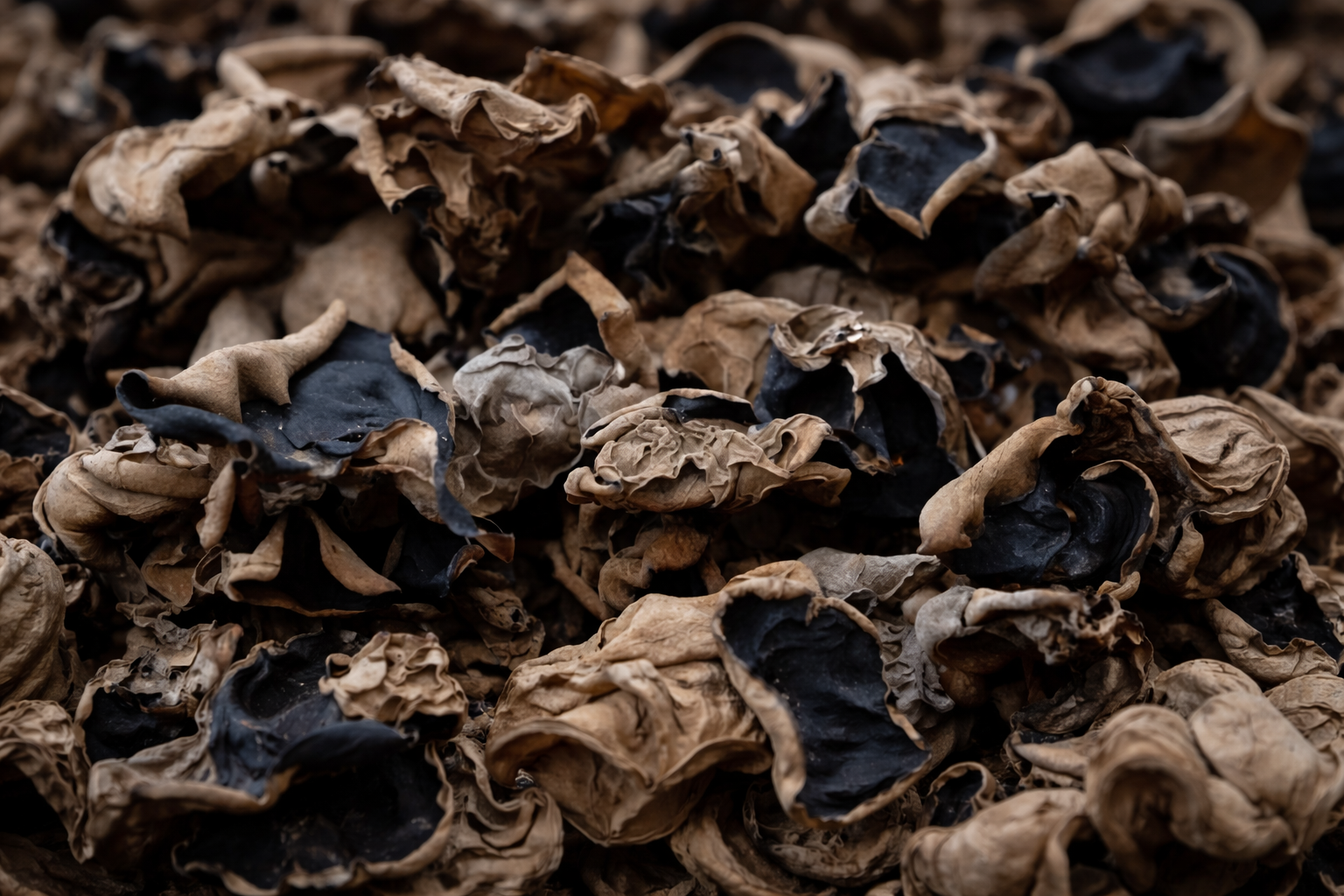
Auricularia auricula-judae stands out among edible mushrooms in two specific ways. First, it contains more dietary fiber than any other edible mushroom - up to 70–80% of its dry weight. Second, its primary active compound is not beta-glucans like most functional mushrooms, but adenosine. These two features determine where and how it works in the body.
What Is Auricularia: A Mushroom with Two Names and a Thousand-Year History
Auricularia auricula-judae grows on dead hardwood - elder, oak, beech. The fruiting body genuinely resembles an ear: thin, cartilaginous, semi-transparent, dark brown. When dried it shrinks dramatically - and fully restores its shape when soaked in water.
Where the Name "Ear of Judas" Comes From
The Latin name auricula-judae - literally "ear of Judas" - appeared in medieval Europe and is recorded in botanical literature from the 16th and 17th centuries. According to the biblical legend, Judas Iscariot hanged himself on an elder tree, and the mushroom that grows on that tree took his name. In English the name "Jew's ear" persists, although "jelly ear" and "wood ear" are more common today. In China, this mushroom was eaten and used medicinally a thousand years before the legend was invented - and there it was never associated with it.
Traditional Use in Asia
The earliest written records of auricularia in Chinese medicine date to the Tang Dynasty (618–907 CE). The mushroom was used to support circulation and recovery after illness. In traditional Chinese medicine it is classified as a food that "nourishes the blood" - a description with a biochemical basis, since the mushroom contains iron in concentrations unusual for plant-based foods. In Japanese, Korean and Vietnamese cuisine it is a standard ingredient in soups, salads and stuffed dishes. Most people in Asia eat it simply because it tastes good - and alongside that, they get everything discussed below.
Where Auricularia Comes From Today
Over 95% of global production comes from China. It is grown on blocks of hardwood sawdust and grain bran. Annual output is approximately 7–8 million tons in fresh-weight equivalent, making it one of the most widely cultivated edible mushrooms in the world. The dried form concentrates all active components - which is why powders and extracts are made from dried fruiting bodies.
What Makes Auricularia Different from Other Mushrooms
Most functional mushrooms are valued primarily for their beta-glucans - polysaccharides that feed the gut microbiome and interact with the immune system. Auricularia contains beta-glucans too, but its defining compound is something else.
Adenosine - What It Is and Why It Matters
Adenosine is a natural compound present in every cell in the body. It regulates blood flow, dampens nervous system excitation and influences heart rhythm. In medicine, adenosine is used as a drug - given intravenously for certain cardiac arrhythmias. In auricularia it is present in free form at higher concentrations than in most other edible mushrooms. Through food, adenosine acts more gradually and gently than through injection - but the underlying mechanism is the same. It is responsible for most of the specific properties of auricularia: effects on blood vessels, heart, kidneys and gut.
Acidic Polysaccharides (AAP) - How They Differ from Standard Beta-Glucans
Auricularia contains a specific type of polysaccharides called AAP. Unlike the neutral beta-glucans found in most mushrooms, these molecules are acidic in character. This changes how they interact with immune cells and how they behave in the gut - forming a gel, slowing glucose absorption and binding bile acids.
More detail: how AAP interacts with the immune system
AAP polysaccharides activate macrophages through TLR-4 and Dectin-1 receptors - immune cells that are among the first to respond to pathogens and tissue damage. The acidic character of these molecules, derived from uronic acids in the chain, produces a distinct interaction with pattern-recognition receptors - somewhat different from the neutral beta-glucans of shiitake or reishi. This means auricularia activates slightly different immune pathways, which may be relevant when combining it with other mushrooms.
Iron, Melanin and Vitamin D2
Dried auricularia contains up to 185 mg of iron per 100 g - more than spinach or lentils. One important caveat: this is non-heme iron, which is absorbed less efficiently than iron from meat. Actual absorption ranges from 2 to 20% depending on conditions. Vitamin C from the same meal - citrus, bell pepper, berries - significantly improves uptake. With regular consumption and sensible food combinations, auricularia becomes a meaningful plant-based iron source.
Melanin - the pigment that gives the mushroom its dark color - has antioxidant activity. Ergosterol in the mushroom converts to vitamin D2 under sunlight during drying.
Auricularia and the Gut: Record-Breaking Fiber
Dried shiitake contains around 11% dietary fiber, reishi around 15–20%. Auricularia comes in at 70–80%. This is not just more - it is a different category entirely. Auricularia works primarily as a fiber source, and only secondarily as an immune signaling agent. This is also what gives it that characteristic gel-like texture when soaked - the mushroom is literally swelling and absorbing water.
What Happens in the Gut
Auricularia's fiber reaches the colon intact and becomes food for the gut microbiome. Bacteria ferment it and produce butyrate - a compound that serves as the primary fuel for the cells lining the colon wall and helps maintain its integrity. Additionally, adenosine in the mushroom acts directly on the gut's nervous system - restoring normal motility in cases of functional disruption. This distinguishes auricularia from laxatives: it does not flush fluid and minerals out of the gut, but restores movement through a nerve-based mechanism.
More detail: what research on the microbiome shows
Sun et al. (2019, Zhejiang University) in mice: eight weeks of auricularia polysaccharide supplementation increased the relative abundance of Bifidobacterium and Lactobacillus , reduced Clostridium and markers of gut inflammation. Kong et al. (Frontiers in Immunology, 2020): AAP polysaccharides restored gut microbiome composition in mice after cyclophosphamide-induced immunosuppression - normalizing the Firmicutes/Bacteroidetes ratio and restoring tight junction proteins Claudin-1, Occludin and ZO-1.
Heart and Blood Vessels: What Adenosine Does
Adenosine dilates blood vessels - this is its primary function in the body. With regular dietary intake, this effect accumulates and influences several organs simultaneously.
Circulation and the Heart
Dilated vessels mean less resistance for the heart - the myocardium does less work to pump the same volume of blood. Coronary arteries supply the heart muscle with more oxygen. For the brain - better cerebral blood flow. For the kidneys - higher filtration rate.
Platelets and Cholesterol
Adenosine and auricularia polysaccharides reduce platelet aggregation - lowering the tendency of blood to clot. The effect is milder and more reversible than aspirin - but precisely for this reason, anyone taking anticoagulants or aspirin should discuss regular use of concentrated forms with their doctor. The combined effect may be stronger than either alone. Auricularia polysaccharides also protect LDL cholesterol from oxidation and bind bile acids in the gut - both mechanisms reduce circulating LDL levels.
Heart Rhythm and Stress
Adenosine dampens the excess effect of adrenaline on the heart during chronic stress - reducing heart rate and supporting autonomic balance. This is not an acute antiarrhythmic effect like pharmaceutical adenosine - it is a gradual systemic support with regular dietary intake.
More details: mechanisms at the molecular level
Adenosine activates A2A receptors on smooth muscle cells of the vessel wall, reducing peripheral vascular resistance. The antiplatelet effect works through inhibition of thromboxane A2 synthesis and activation of prostacyclin (Yoon et al., 2003) - these two molecules regulate the balance between aggregation and vasodilation. The effect on heart rhythm operates through adenosine receptor activation in the sinoatrial node, slowing atrioventricular conduction (Berne, 1980; Pelleg & Porter, 1990).
Immune System and Inflammation
AAP polysaccharides interact with immune cells in the gut wall and activate macrophages - cells that are among the first to respond to pathogens and damage. This is a dietary level of immune support - not stimulation, but support for normal function.
Adenosine additionally reduces inflammatory signaling in joints and mucous membranes - which explains the traditional use of auricularia for joint pain and mucosal dryness. In Sjögren's syndrome - an autoimmune condition involving dry eyes and mouth - adenosine may increase fluid supply to the lacrimal and salivary glands through improved microcirculation. Clinical studies in humans are limited here, but the mechanism is sound.
Kidneys, Skin and Iron
Kidneys
Adenosine dilates the small arteries supplying the kidneys and increases the glomerular filtration rate - the key measure of kidney function. It also reduces ureteral spasm, which may help small kidney stones pass more easily.
Better microcirculation means more fluid and nutrients reaching the surface layers of the skin. Traditional use of auricularia for dry skin is documented (Halpern, 2007) - and has a physiological explanation through the adenosine mechanism.
Iron in Practice
185 mg of iron per 100 g dry weight is a striking number, with an important qualifier: this is non-heme iron, absorbed at 2 to 20% depending on conditions. To get the most from it: pair with vitamin C-rich foods - orange, lemon, bell pepper, kiwi. With regular consumption, auricularia becomes a meaningful plant-based iron source.
Oncology Research-What the Studies Show
Supporting the Body During Chemotherapy
Chemotherapy suppresses the immune system and disrupts gut microbiota as a side effect. Kong et al. (Frontiers in Immunology, 2020) in mice showed that auricularia polysaccharides given alongside chemotherapy restored immune markers and normalized gut microbiome composition. Auricularia partially offset these side effects in a mouse model.
Preclinical and Clinical Data
In mouse tumor models - including Sarcoma 180 and hepatoma H22 (Ying et al., 2007) - polysaccharide extract inhibited tumor growth by 40–60% through immune cell activation. A systematic review and network meta-analysis (ScienceDirect, 2018) assessed the standardized preparation Huaier, based on auricularia polysaccharides, as an adjuvant in gastrointestinal cancers - and found clinical benefit in combination with chemotherapy.
An Important Distinction
Huaier is a pharmaceutical preparation with a fixed polysaccharide concentration, used in oncology protocols in China. The clinical data apply to it - not to dietary consumption of the mushroom or food-grade extracts. Auricularia as a food is not a substitute for cancer treatment. Regular consumption as a source of fiber, iron and antioxidants may be part of nutritional support - any decisions in the context of cancer care should be made with an oncologist.
Powder, Extract or Capsules - Which Form for Which Purpose
Choosing a form is a question of goal and convenience, not quality. All three contain the active components of auricularia - in different proportions and with different practical logic.
Whole Fruiting Body Powder
Retains everything the mushroom contains: 70–80% fiber, iron, melanin, adenosine and polysaccharides in their natural ratio. Does not fully dissolve in water - best brewed in hot water for 10–15 minutes or stirred into soups and porridge. During heating, adenosine and polysaccharides transfer into the liquid. Best for daily dietary enrichment - fiber, iron, full spectrum of components.
Extract 20%+ Beta-Glucans
A water-based fruiting body extract with a standardized beta-glucan concentration of 20% and above. Polysaccharides are already released from the cell wall and are readily bioavailable. Less fiber than in the powder, but a more precise and consistent immune and cardiovascular signal. Best when a specific dose and a targeted effect are the priority.
Capsules
The same 20%+ extract in a capsule shell. Convenient: fixed dose, nothing to dissolve, no taste. For those who want regular intake without a culinary context.
Side Effects and Contraindications
Anticoagulants and Antiplatelet Drugs
Auricularia reduces blood clotting tendency - a documented effect. Anyone taking warfarin, aspirin, clopidogrel or other medications that affect clotting should discuss regular use of concentrated forms with their healthcare provider. The combined effect may be stronger than either alone.
Pregnancy
Some sources indicate a possible effect of auricularia on uterine smooth muscle tone - the mechanism is not fully established. Moderate dietary consumption has no documented contraindications. Concentrated forms - large amounts of powder, extract or capsules - during pregnancy or when trying to conceive should only be used after consulting a healthcare provider.
Kidneys, Children, Allergy
With chronic kidney disease - intake should be discussed with a nephrologist due to potassium and phosphorus content in concentrated forms. With mushroom hypersensitivity - caution is warranted. For children, there is insufficient clinical data on extracts and capsules - decisions should be made with a pediatrician.
How to Include Auricularia in Your Diet
Auricularia works through regular intake, not a single dose. Microbiome changes are recorded after 6–8 weeks. Cardiovascular effects accumulate gradually. Iron absorption builds with daily use alongside vitamin C.
Powder - into hot water, broth or porridge. Extract and capsules - with water at any time of the day. When increasing fiber intake quickly, some temporary bloating is normal - it is the microbiome adjusting to a new substrate and passes within a few days.
Auricularia rarely gets the attention it deserves. But among edible mushrooms it occupies a unique position: record fiber content, a distinct adenosine profile and documented effects across several body systems.