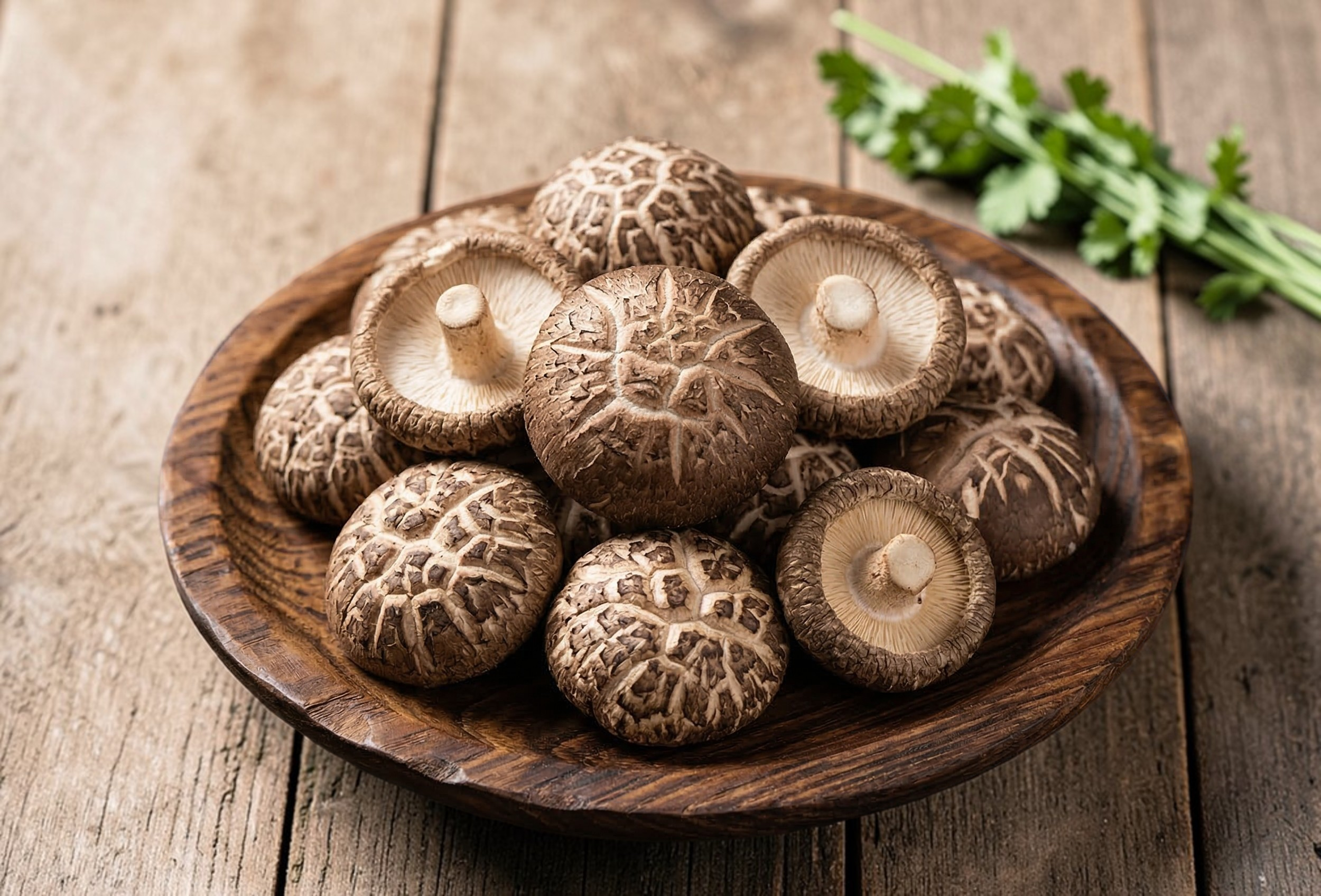
In 1964, Japan's health authorities launched a large-scale epidemiological study to map the distribution of chronic diseases across the country. The findings revealed an anomaly: two regions showed significantly lower rates of illness and consistently higher life expectancy. Follow-up research traced a common factor - shiitake mushroom was a regular part of the daily diet in both areas. That observation triggered a wave of scientific investigation that eventually extended well beyond epidemiology.
What Is Shiitake: A Mushroom with a Thousand-Year History
Shiitake (Lentinula edodes) is an edible mushroom of the Marasmiaceae family. In the wild, it grows on decaying hardwood - primarily oak, chestnut and hornbeam - in the temperate and subtropical forests of East Asia. The name comes from Japanese: shii refers to a species of oak in the genus Castanopsis, and také means mushroom.
Cultural and Traditional Use
The earliest written records of shiitake in China date to the Song Dynasty, roughly the 10th-11th centuries CE. In traditional Chinese medicine, the mushroom was used to support digestion, circulation and general vitality during periods of exhaustion. The 13th-century physician Wu Rui described it as a remedy that strengthens the body during colds and supports appetite. In Japanese culture, shiitake held a place of prestige - it was served at weddings and offered as a gift to people of authority. Dried shiitake was a staple in the diet of Buddhist monks following vegetarian practice, partly compensating for the protein and micronutrient gaps of a plant-based diet.
Early Cultivation
The earliest documented cultivation attempts trace back to China around 1000 CE. The method involved scoring the surface of felled logs and transferring mycelium from trees where shiitake grew naturally. Japanese records from the 17th century describe a technique of forced fruiting through mechanical stress - striking the logs to initiate growth. Industrial cultivation on prepared oak logs spread throughout Japan in the 19th century. The shift to substrate cultivation - growing on blocks of sawdust and grain bran - came in the second half of the 20th century and enabled large-scale production. Today, shiitake ranks second globally in cultivated mushroom output, behind only the common button mushroom.
What's Inside Shiitake - and Why It Matters
Shiitake is not a single-compound product. Its biological value comes from several classes of substances that work in parallel and partially amplify each other's effects.
Complete Amino Acid Profile: Unusual for a Plant-Based Source
Dried shiitake contains all eight essential amino acids: leucine, isoleucine, valine, threonine, methionine, phenylalanine, tryptophan and lysine. This is uncommon for a plant-based food - most plant proteins are deficient in one or more essential amino acids. Total protein content in dried shiitake ranges from 13 to 18% of dry weight. The mushroom also contains free lentiionine, a sulfur compound responsible for the characteristic aroma and documented antibacterial activity in vitro.
The micronutrient profile is equally notable: zinc, copper, selenium and manganese are present in meaningful concentrations. Selenium in particular - an antioxidant micronutrient - is commonly deficient in populations with low intake of seafood and organ meats.
Ergosterol and Vitamin D2: Why Drying Method Matters
Shiitake contains ergosterol, a precursor to vitamin D2. Under ultraviolet light, ergosterol converts to ergocalciferol. The key point: this conversion depends entirely on how the mushroom is dried. Research from Boston University Medical Center (Holick, 2011) showed that mushrooms dried gill-side up in direct sunlight can contain up to 46,000 IU of vitamin D2 per 100g - compared to roughly 100 IU in mushrooms dried in shade or by artificial heat. Most commercially dried products do not come close to realizing this potential.
How Shiitake Affects Digestion and the Gut Microbiome
Dietary Fiber and Trehalose as Prebiotics
Dried shiitake contains approximately 11% dietary fiber by weight - a combination of chitin and β-glucans. These fibers pass through the small intestine undigested and reach the colon intact, where they serve as substrate for gut bacteria. Trehalose deserves specific attention: this disaccharide, present in shiitake in meaningful concentrations, acts as a selective substrate for Lactobacillus brevis and Bifidobacterium breve - two key members of the beneficial gut microbiota. This makes shiitake more than a generic fiber source: it provides selective nourishment for specific microbial strains.
Short-Chain Fatty Acids and Gut Barrier Integrity
Bacterial fermentation of shiitake fiber produces short-chain fatty acids, primarily butyrate and propionate. Butyrate is the primary energy source for colonocytes - the cells lining the colon - and plays a central role in maintaining the integrity of the gut barrier, reducing its permeability to bacterial toxins and small molecules. A study from the University of Hong Kong (2015) conducted in mice found that eight weeks of shiitake extract supplementation shifted the composition of the gut microbiota toward a profile associated with lower systemic inflammation and reduced body weight. Direct translation to humans requires clinical confirmation, but the butyrate mechanism itself is well-established regardless of the fiber source.
A healthy gut microbiome is not just a local effect. The lymphoid tissue distributed along the intestinal wall accounts for a large portion of the body's immune capacity. A gut with balanced microbiota and an intact epithelial barrier reduces systemic inflammatory load and limits the entry of bacterial toxins into circulation. This is why shiitake's influence on the microbiome has consequences that extend well beyond digestion.
The Immune System - Dietary-Level Influence
Gut-Associated Lymphoid Tissue as the Entry Point
The wall of the small intestine contains clusters of lymphoid tissue - specialized structures that form the first line of immune recognition for what enters through food. The β-glucans in shiitake interact with immune cells in these structures via Dectin-1 receptors, triggering a cascade that raises immune readiness without causing overactivation. This is a fundamental distinction from pharmacological intervention: it is not stimulation, but support for the normal function of mucosal immunity.
What the Randomized Trial at the University of Florida (2011) Found
The Percival et al. study enrolled 52 healthy adults over four weeks. Participants consumed 5-10g of dried shiitake daily. Results showed increased proliferation of γδ T-cells - a population of lymphocytes that patrol mucosal surfaces and are among the first to respond to pathogens - as well as elevated secretory immunoglobulin A (sIgA) in saliva. Secretory IgA is a key marker of mucosal protection in the respiratory tract and gastrointestinal system. The effect was observed at dietary doses, without any additional supplements or concentrated extracts. This is one of the few randomized studies of a dietary mushroom conducted in healthy subjects - not in patients and not in animal models.
Shiitake and Oncology Research - What the Studies Show
Sarcoma 180 and Early Mouse Studies: What Chihara Found
Between 1969 and 1970, Chihara Goro's research group published results from a series of experiments in mice implanted with Sarcoma 180 - a standard model for testing antitumor activity. Administration of purified lentinan inhibited tumor growth and increased animal survival. An important distinction: the mechanism was not direct cytotoxic action on tumor cells, but activation of the body's own immune response - primarily natural killer cells and macrophages. This was conceptually significant: not a chemical attack on the tumor, but an enhancement of immune surveillance. These publications in Cancer Research and Nature launched two decades of clinical research in Japan.
From Mice to the Clinic: Where the Evidence Base Ends
During the 1970s and 1980s, lentinan gained approved adjuvant status for gastric cancer chemotherapy in Japan, based on clinical data showing improved survival when used in combination therapy. This applies exclusively to injectable pharmaceutical-grade lentinan at controlled dosages - not to dietary shiitake consumption. Oral lentinan from food or powder is partially degraded during digestion; its systemic bioavailability at dietary doses is considerably lower than in injectable form. These two contexts - pharmacological and dietary - should not be conflated.
Dietary Support in Oncology - The Role of Functional Mushrooms
The data cited above relate to preclinical and limited clinical research on injectable lentinan. Shiitake is not, and is not to be considered, a substitute for oncological treatment. That said, regular dietary consumption of shiitake as a source of β-glucans, complete protein and micronutrients may form part of a balanced diet - including in the context of general nutritional support. Any dietary decisions in the context of an oncological diagnosis should be made individually in consultation with a physician.
Cardiovascular and Lipid Metabolism
Eritadenine - a Molecule Unique to Shiitake
Eritadenine is an adenosine-like compound not found in any other edible mushroom. Its mechanism of action: it inhibits the enzyme S-adenosylhomocysteine hydrolase, which influences the methylation of phosphatidylcholine in the liver and reduces the synthesis and transport of LDL cholesterol. This mechanism differs from that of statins - eritadenine does not directly block cholesterol synthesis, but affects its transport metabolism.
What Mouse Studies Showed and What Was Confirmed in Humans
A series of studies from the University of Shizuoka (1990s-2000s) in mice demonstrated consistent reductions in total cholesterol of 15-25% with eritadenine supplementation. The cohort observation by Enman et al. (2007) recorded lower LDL levels in groups with traditionally high dietary shiitake consumption in Japanese populations. Human interventional data remain limited in sample size - but the eritadenine mechanism is biochemically confirmed, and the hypothesis of a dietary lipid-modulating effect with regular consumption is well-grounded.
Oral Health and Bone Health
Oral Cavity: Antibacterial Protection Through Microbiome Balance
Shiitake inhibits colonization of the oral cavity by bacteria responsible for dental plaque formation - primarily Streptococcus mutans. Research by Shouji et al. (2000) and subsequent work by Zaura et al. (2011) confirmed that shiitake extract reduces biofilm formation on tooth surfaces and decreases the activity of cariogenic bacteria. The mechanism mirrors what occurs in the gut: normalization of microbial balance by supporting beneficial strains and suppressing pathogens, rather than antibiotic-style elimination of the entire flora. This aspect is rarely mentioned in discussions of functional mushrooms, despite having a reasonably solid evidence base.
Bones: Vitamin D2 and Mineral Absorption
Shiitake's influence on bone tissue involves two mechanisms. The first is direct: it supplies vitamin D2, which is required for calcium deposition in bone. The second is indirect: a healthy gut with balanced microbiota absorbs minerals more efficiently, including calcium and magnesium. These two mechanisms work together - and their combination is why researchers have linked regular shiitake consumption to support for bone mineral density (Halpern, 2007; Lee et al., 2009).
Powder vs. Extract - Which Form for Which Purpose
Dietary Enrichment: The Logic of Powder
Dried fruiting body powder preserves the full matrix profile of shiitake: dietary fiber, trehalose, eritadenine, ergosterol, amino acids and micronutrients. Beta-glucan content sits at 4-7% of product weight. The powder does not dissolve in water - it is brewed or added to food. This is the form closest to whole-food consumption: the body receives the full spectrum of components in their natural ratio. The use case is daily dietary enrichment, analogous to regularly eating the whole mushroom.
Targeted Support: The Logic of Extract
A water-based fruiting body extract contains a standardized concentration of β-glucans - typically 30% and above. During extraction, water-soluble polysaccharide fractions are released from the cellular matrix and become bioavailable regardless of individual digestive variation. Some matrix components - insoluble fiber, certain fat-soluble fractions - are reduced or absent in the extract. The use case is when a predictable β-glucan concentration and targeted immune support are the priority.
The choice between forms is not a question of product quality - it is a question of intent. Powder makes sense as a regular dietary component with a broad-spectrum profile. Extract is appropriate when a precise, standardized dose of β-glucans with predictable bioavailability is the goal.
Side Effects and Contraindications
Skin Reactions and Shiitake Dermatitis
The most well-documented adverse effect is shiitake dermatitis. It occurs following consumption of insufficiently cooked or raw shiitake and presents as linear skin eruptions - described in medical literature as flagellate dermatitis. The mechanism is attributed to lentinan in its heat-labile form, which degrades at temperatures above 70°C (158°F). The reaction resolves on its own but may persist for several weeks. Full thermal cooking eliminates this risk - applicable to both fresh and dried mushroom. Powder made from heat-processed material and standardized extracts do not carry this risk.
Drug Interactions
Concentrated forms of shiitake - particularly extracts with high β-glucan content - may potentiate the effects of anticoagulants, including warfarin, through an influence on platelet aggregation. There is also potential interaction with immunosuppressants: immune activation may compete with the therapeutic effect of these medications, which is particularly relevant for transplant patients or those with autoimmune conditions. For anyone taking regularly prescribed medications, consulting a physician before introducing concentrated shiitake forms is a reasonable precaution.
Shiitake During Pregnancy and for Children - What Is Known
Shiitake as a food has no documented contraindications for pregnant women or children at moderate dietary intake - the mushroom has been part of traditional diets in Asian cultures for centuries without noted concern. Systematic clinical data on concentrated extracts in pregnant women and children are insufficient to support formal recommendations. Decisions about regular use in supplement or extract form during pregnancy, breastfeeding or in children should be made individually with a healthcare provider.
How to Include Shiitake in Your Diet Systematically
The dietary effects of shiitake are neither immediate nor accumulative in the conventional sense. The University of Florida study recorded changes in immune markers after four weeks of regular consumption. Microbiome data point to shifts emerging over eight weeks. Eritadenine acts through gradual metabolic recalibration. This is a food for regular inclusion - not a protocol with a start and end date.
Fruiting body powder can be added to broths, sauces, porridge or hot drinks - heat does not degrade β-glucans, but does eliminate heat-labile components and removes the risk of skin reactions. Extract dissolves in water and can be taken on its own or with food - a practical option for those who want a standardized dose without a culinary context.
The systematic approach here aligns with the general logic of evidence-based nutrition: not seeking one component with maximum effect, but consistently including foods with a confirmed mechanism of action within the context of a varied and balanced diet. In that framework, shiitake is one of the few dietary mushrooms for which the mechanisms are documented in sufficient detail to speak about them precisely - not in generalities.